
Deployable AI vs Custom AI: How to Choose Without Wasting Your Investment
· Hui Huang
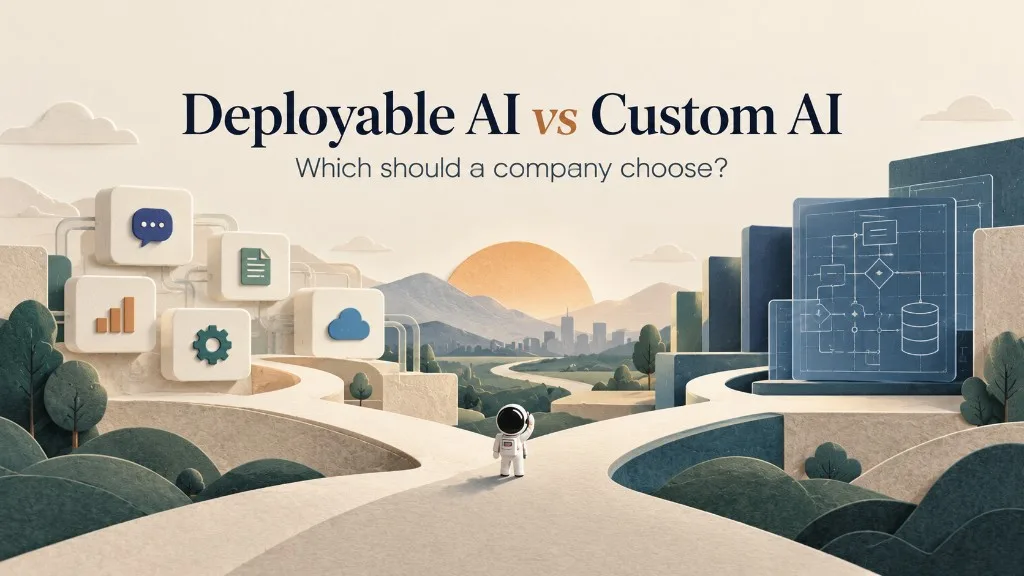
The most expensive AI decision isn’t choosing the wrong model. It’s building the wrong solution for the business problem.
Every company is being pushed to adopt AI. The harder question is what to invest in.
Should you buy an existing AI solution and connect it to your operations? Build a custom system around your business? Or combine both?
Short answer: Choose Deployable AI when the workflow is common, the solution is proven, and speed to value matters. Choose Custom AI when you need proprietary logic, deep integration, or operational control that products cannot give you. Choose hybrid when standard AI can handle most of the work, but your differentiating processes need custom engineering.
And if you cannot describe the business outcome you expect, neither approach is ready for investment.
The decision is less about how fancy the AI looks and more about how much uncertainty your company is prepared to own.
Two ways to invest in AI
Deployable AI: start with something that already works
Deployable AI means existing products or reusable systems you configure and integrate, without building the core capability from scratch.
Think customer support assistants, document processing, sales research tools, and workflow automation.
A logistics company might deploy document processing to pull shipment details from incoming emails and attachments. The extraction capability already exists. The company mainly connects its data, sets review rules, and plugs the system into operations.
The advantage is speed. You avoid rebuilding what already works.
Deployable is not effortless. Data quality, integration, security, adoption, and exceptions stay on you. A demo that looks clean can still take real work to run reliably in production.
Custom AI: build around how you actually operate
Custom AI means systems designed around your processes, data, decisions, and constraints.
Take a freight operator that needs more than document extraction. It has to compare emails, bills of lading, rate confirmations, and shipment records, flag discrepancies, decide which exceptions need a person, and start approved actions.
The hard part is no longer reading documents. It is coordinating decisions across systems while keeping accountability clear.
That is where custom AI may be necessary.
You get more control over interpretation, decisions, and actions. You also own engineering quality, testing, security, monitoring, maintenance, and improvement.
The distinction is not whether AI is involved. It is how much of the business process you must design and control.
Compare the trade-offs before you compare vendors
These are tendencies, not guarantees.
A heavily customized commercial product can cost more than a focused custom app. A custom build on managed AI services can sometimes reach production quickly. Neither path is automatically cheaper or safer.
Compare the total cost of getting and keeping the business outcome: implementation, licenses, integrations, AI usage, human review, evaluation, security, support, and future change.
Five questions before you invest
At Skyline Dev Labs we use an outcome-first approach. This five-question test turns that into a practical decision.
1. Can you define the business outcome?
“Use AI to improve efficiency” is not a goal you can measure.
“Reduce the time employees spend reviewing shipment documents while keeping accuracy” is closer.
Name the work, the current cost, the expected result, and how you will know it worked.
If those are fuzzy, run a focused discovery or feasibility exercise before you buy or build.
2. Is your workflow standard or differentiated?
Some work is common across thousands of businesses: summarizing meetings, categorizing support requests, extracting invoice fields, drafting routine messages. Those are often good deployable AI candidates.
Other workflows are how you compete. They depend on proprietary rules, relationships, institutional knowledge, or unusual operations. Those lean custom.
Useful test: If competitors bought the same AI product tomorrow, would we still have an advantage?
If yes, because your edge lives elsewhere, a proven product may be enough.
If no, because your unique processes are the edge, you may need to own more of the solution.
3. How deeply must AI work with your systems?
A standalone assistant that drafts a reply is a different problem from an agent that reads customer records, updates a system of record, and triggers financial or operational actions.
List the systems AI must touch. Separate reading, recommending, and executing.
The deeper the integration and the more consequential the action, the more architecture, authorization, testing, and traceability matter. Custom is not always required, but a simple off-the-shelf tool may stop being enough.
4. What happens when AI gets something wrong?
Every AI system errs. What matters is the consequence.
A flawed internal summary is usually fixable. A wrong operational update, customer commitment, or financial action can do real damage.
That is why we separate AI that generates information, AI that supports decisions, and AI that takes action.
As failure gets more expensive, you need stronger controls: validation, evaluation, human approval, audit trails, recovery. Buying a product does not move accountability off your company.
5. Do you need to own the capability?
Ownership is more than source code.
It means changing business rules, accessing important data, switching providers, understanding behavior, and keeping the lights on when requirements shift.
If a product meets those needs at an acceptable cost, ownership may add little.
If the capability sits at the center of strategy, vendor limits and switching costs deserve a hard look. Custom becomes more compelling when control is required for differentiation, reliability, or long-term economics.
The third option: deploy the common, build the different
Many companies do not need all packaged software or an all-custom platform.
Use existing AI for common functions. Build a focused layer around what makes your operations different.
An operations team processing customer requests might use one service to extract document fields, another to classify intent, and a workflow tool for notifications.
What may need custom engineering is the decision layer: how conflicts get resolved, which records win, when people must approve, and how changes land in operational systems.
Use existing AI for capabilities that are broadly available. Put custom engineering into the business logic, integration, and controls that are unique to you.
Revisit that boundary as the tech and the business change.
Three examples
A. Small company wants faster customer support
Repetitive questions, a mainstream helpdesk, drafts for human review.
Likely choice: Deployable AI. Common workflow, products you can evaluate quickly, metrics you can watch. Custom only when a real requirement stays unmet.
B. Freight operator needs document verification
Documents arrive from many parties and must be checked against internal records, rules, and customer commitments.
AI can interpret unstructured files, but reliable verification needs deterministic checks, evidence references, exception handling, and ties into ops systems.
Likely choice: Hybrid or Custom AI. Models and extraction services supply capabilities; company-specific verification and action flow often need custom work.
C. Healthcare SaaS wants an AI operations assistant
Sensitive data, several internal systems, tight permissions.
A standalone assistant is easy to try. Acting across those systems needs a careful look at access, data handling, reliability, and regulatory obligations.
Likely choice: Feasibility first, then hybrid or custom. Architecture depends on the workflow, integrations, and risk. Custom alone does not equal compliance or safety.
Choose the workflow before you choose the stack.
Reduce uncertainty before you increase investment
The common failure mode is jumping from a flashy demo to a full build.
Better sequence:
- Establish business value. Is the problem frequent, expensive, and consequential enough?
- Test feasibility. Products, integrations, data readiness, accuracy needs, operational risk.
- Validate a narrow workflow with real inputs. Compare against today’s process.
- Scale only when the evidence supports it.
That path works for deployable, custom, and hybrid.
It also changes the question to ask a partner. Not “Can you build this with AI?” Ask: “What evidence would convince us this is worth building, buying, or deploying?”
Bottom line
Deployable AI and custom AI are not rival religions. They are different investment shapes.
Choose deployable when proven capabilities solve a common problem with acceptable integration and risk.
Choose custom when the workflow needs distinctive logic, deep integration, or control products cannot reasonably provide.
Choose hybrid when you can reuse commodity capabilities and spend custom engineering on your advantage.
When the outcome is still fuzzy, buy clarity before you buy implementation.
The best AI decision is not always the most ambitious one. It is the one that delivers measurable value at a cost, complexity, and risk level your business can carry.
How Skyline Dev Labs helps
We help companies move from AI ideas to systems that run in operations: opportunity assessment, Deployable AI, and Custom AI, including AI Innovation Sprints when you need evidence before a larger bet.
Not sure which path fits? Start with an opportunity assessment. Name the workflow, compare realistic options, and define the evidence you need before a bigger commitment.
Stay Updated
Get notified when we publish new insights on AI transformation