Prompt Routing vs. Decision Routing
· Hui Huang
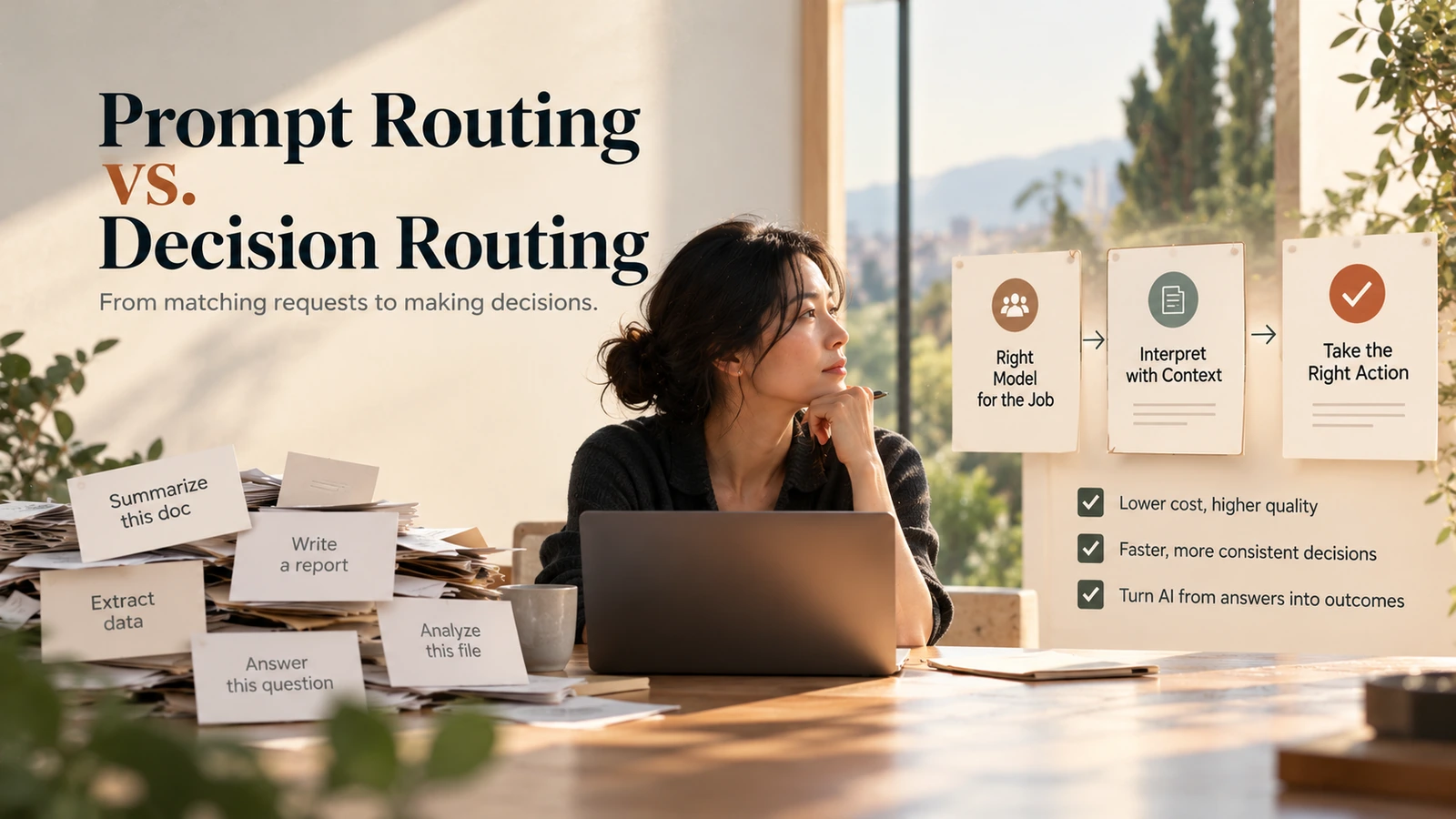
Why reliable AI applications need more than a smarter system prompt.
Most AI apps start simple: take a request, send it to a language model, return the reply. As the product grows, that same call starts doing more. It names the intent, picks a workflow, chooses tools, interprets policy, decides whether a human must approve, and writes the response.
Use a decision layer instead of prompt routing when the assistant selects among different operations, applies business policy, or calls privileged tools. Keep models for ambiguous interpretation. Put known constraints and authorization in code where you can test and enforce them.
Understanding a request is not the same as deciding what the system is allowed to do with it. A model can hear “I want my money back” as a refund. Whether the customer qualifies still depends on account status, payment history, contract terms, and approval thresholds.
When all of that lives in one prompt, the app can no longer tell language interpretation apart from business policy or operational authority. A better prompt may change the behavior. It does not remove the coupling.
1. The Problem Is Not the Prompt
Eventually the system prompt becomes an informal execution engine. Several different classes of decision share one probabilistic path.
That is the architectural problem, not whether the model can reason about refunds.
2. Anatomy of a Prompt Router
Take a customer-support assistant with five capabilities: answer product questions, explain billing, investigate refunds, update subscriptions, and escalate unresolved issues.
A typical build dumps the conversation, account context, available tools, and routing instructions into one model call.
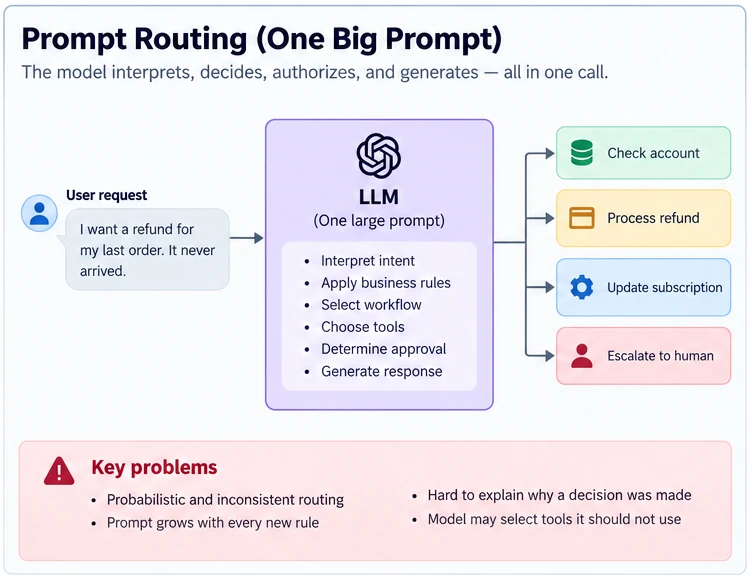
Figure 1. Prompt routing combines interpretation, policy, workflow selection, and response generation in one model-driven path.
Flexibility is real. The model can handle unfamiliar phrasing without every branch being coded up front.
The costs show up later. Routing still rides a probabilistic model. Temperature and structured outputs reduce noise, but they do not make semantic classification deterministic. Policy changes couple to the prompt, so a new billing rule can change how unrelated requests get read. Tool availability and permission blur: selecting a function is not the same as being allowed to run it. Observability stays thin. A trace may show which tool fired without showing which policy justified it.
The sharp failure mode is not one wrong reply. It is the missing, independently enforceable decision contract between the model and the business system.
3. Separate Understanding From Authority
An alternative puts a decision boundary before a workflow runs.
The point is not to strip reasoning from the model. It is to route each decision by its nature.
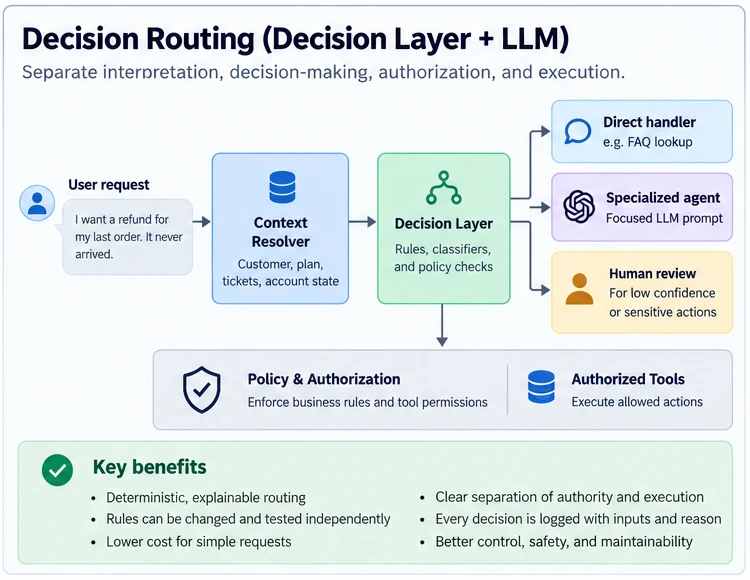
Figure 2. A decision layer separates request interpretation from execution authority.
I find three categories useful.
Deterministic decisions follow known facts and explicit policies: entitlements, numeric thresholds, access permissions, workflow state. Handle them in code.
Probabilistic decisions need interpretation of incomplete or ambiguous evidence: classifying a request, spotting an escalation, picking the most relevant specialist workflow. Use a model, and require structured outputs you can evaluate on their own.
Human decisions need authority, accountability, or help with unresolved ambiguity: exceptional refunds, sensitive account changes, uncertain business judgment.
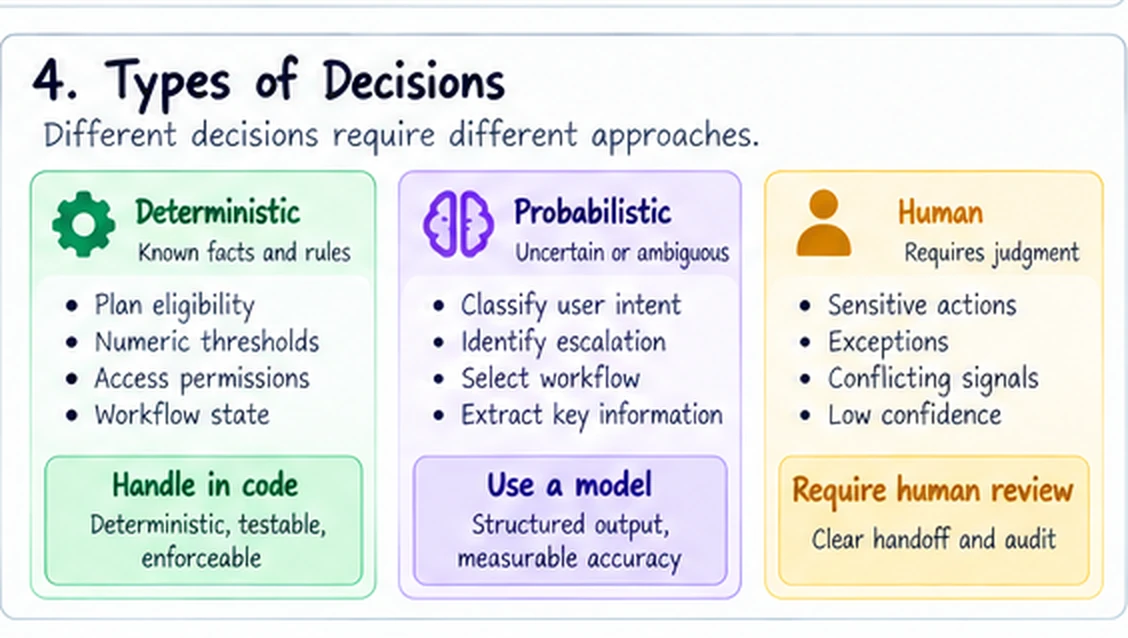
Figure 3. Route each decision according to its nature rather than delegating every judgment to one LLM.
Do not collapse those into one line like “Use your best judgment and escalate when appropriate.”
The decision layer does not have to call a model on every request. A button click may name the workflow. A known API event may map straight to a handler. Ambiguous natural language may need a small classifier or a heavier reasoning model.
That gives you multiple paths with different costs and guarantees. A decision layer is not “another LLM call in front of every LLM call.” That often adds latency and cost without fixing the coupling. It is a way to choose how much reasoning a request deserves.
4. Make the Decision an Explicit Contract
The simplest improvement is to define what a routing decision must return.
Ask the router for a typed decision instead of asking the model to both choose and perform the work.
type RoutingDecision = {
  route:
    | "product.answer"
    | "billing.explain"
    | "refund.review"
    | "subscription.manage"
    | "human.escalate";

  source: "rule" | "model";
  confidence: number | null;
  evidenceRefs: string[];
  reasonCode: string;
  policyVersion: string;
};
The output should let downstream code validate the route and explain the selection.
This is where structured decision models or a Decision API become useful. Instead of asking a model for a long story about its internal reasoning, ask it to resolve a narrow decision from available evidence.
For example:
{
  "route": "refund.review",
  "source": "model",
  "confidence": 0.92,
  "evidenceRefs": [
    "message:current",
    "invoice:742"
  ],
  "reasonCode": "REFUND_INTENT",
  "policyVersion": "routing-v3"
}
The value 0.92 is illustrative. A confidence number helps only if you document what it means and measure calibration on representative data.
Notice what is missing: permission to issue a refund.
Classification names the workflow. A separate authorization boundary decides whether the action is allowed.
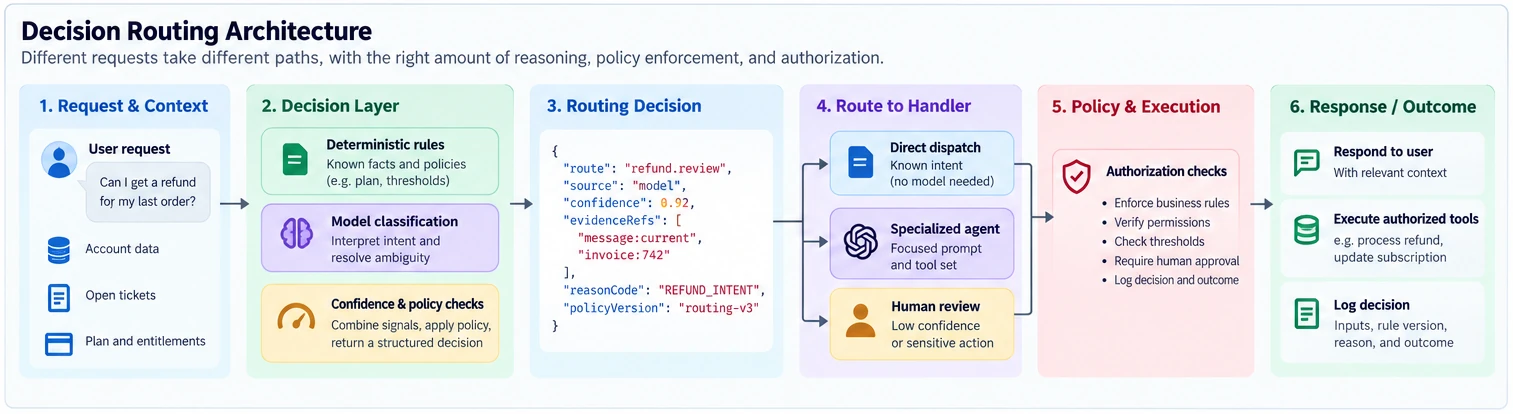
Figure 4. The routing contract passes a typed decision to the chosen handler; authorization is checked before execution.
Structured output is not reliable judgment. A model can emit valid JSON with the wrong decision. Schema checks prove shape, not semantic correctness or business authorization.
5. Put Business Invariants in Code
Suppose support gets a $750 refund request. Policy allows automated refunds up to $100 when eligibility holds. Larger amounts need human approval.
A prompt-only system might say:
Never issue refunds above $100 without human approval.
That is useful guidance. It is not an authorization control.
The rule belongs at the execution boundary:
function authorizeRefund(input: {
  amount: number;
  eligible: boolean;
  approvedByHuman: boolean;
}) {
  if (!input.eligible) {
    return { allowed: false, reason: "INELIGIBLE" };
  }

  if (input.amount > 100 && !input.approvedByHuman) {
    return {
      allowed: false,
      reason: "APPROVAL_REQUIRED"
    };
  }

  return { allowed: true };
}
In production, human approval must come from a trusted approval record, not from a model field or a claim in the user message. The execution service still enforces identity, permissions, transaction limits, and state checks.
The split is deliberate. The model may say what the user wants. The decision layer may pick the workflow. The policy engine says whether the operation is permitted. The tool executor runs only authorized actions.
The LLM is no longer the final authority over business operations.
6. The Economics of Routing
A decision layer has its own infrastructure and ops cost. Justify it with measurement, not instinct.
Consider a hypothetical app at 50,000 requests per month.
In the prompt-routing design, each request carries 6,000 input tokens of shared instructions and context, before user messages and output. That is 300 million input tokens per month from that routing payload alone.
Now introduce three paths:
| Path | Traffic share | Routing mechanism |
|---|---|---|
| Direct | 40% | Deterministic dispatch |
| Classified | 45% | Small decision model |
| Complex | 15% | Full reasoning model |
Assume classified requests use 500 routing input tokens and complex requests keep the original 6,000-token routing context.
Routing input falls to about 56.25 million tokens per month, an 81.25% reduction from 300 million.
That is not an 81.25% cut in the whole LLM bill. Downstream agents still spend tokens, classifiers emit output, and caching can make the original design cheaper than raw counts suggest.
The real cost model is:
Total request cost = routing cost + downstream model cost + tool cost + infrastructure cost + review cost.
The point of the exercise is architectural: not every request should pay the reasoning cost of the hardest request.
Latency moves too. A classifier then a generation model can slow requests that used to need one call. Direct dispatch can be faster; unnecessary model routing can be slower.
Optimize for end-to-end cost and latency at acceptable quality and risk, not for the routing model’s tokens in isolation.
7. How to Evaluate Whether It Actually Works
Judge a routing architecture on application behavior, not on whether the diagram looks cleaner.
Start with a representative, privacy-reviewed sample. Each example needs account state, the expected route, applicable constraints, and the evidence required to decide.
Include ordinary requests, ambiguous language, overlapping intents, missing context, and adversarial or misleading inputs.
I would measure five outcomes:
| Metric | What it measures |
|---|---|
| Routing accuracy | Agreement with reviewed expected routes |
| Critical misroute rate | Frequency of mistakes with material consequences |
| Policy violation rate | Unauthorized actions attempted or completed |
| Cost per resolved request | End-to-end operating cost, including retries and review |
| Decision trace coverage | Percentage of decisions with usable provenance and policy versions |
Track latency, abstention rate, and human-review volume alongside those.
One accuracy number is not enough. Treating a product FAQ as a billing question is not the same as wrongly authorizing a financial transaction. Weight error severity and inspect failures by route.
Shadow evaluation helps. Keep the current router in production while the proposed decision layer processes the same eligible inputs. Compare both against reviewed outcomes, not only against each other. Matching the old prompt is not proof of correctness.
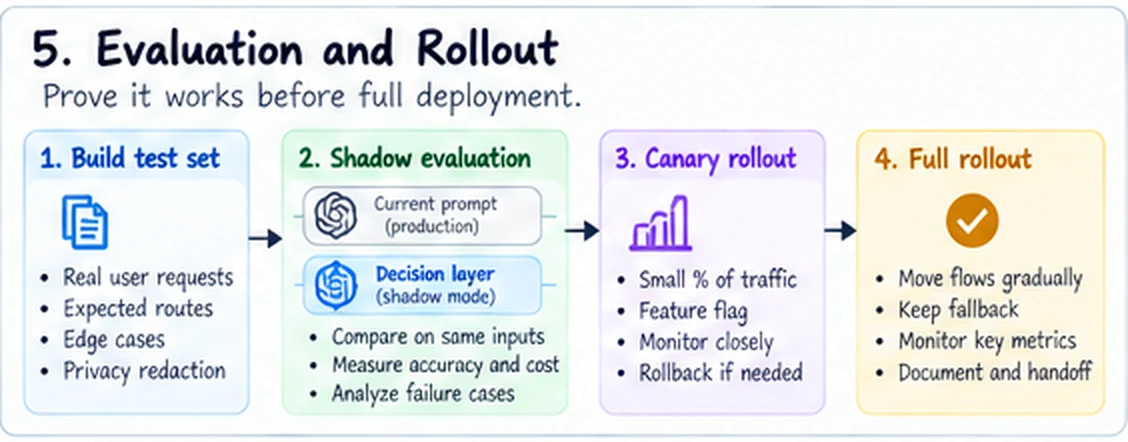
Figure 5. Validate decisions before switching production traffic; keep monitoring and rollback mechanisms in place.
After offline and shadow work, a canary can send a small share of traffic to the new architecture. Feature flags, versioned policies, and rollback make regressions isolatable.
Fail closed for authorization-sensitive actions. An unavailable router must not silently hand more authority to a fallback model.
8. A Decision Layer Is Not a Universal Solution
Sometimes a separate decision layer is not worth it.
A single-purpose conversational interface with no external actions may gain more from prompt work, retrieval, or model evaluation. An app with two or three stable branches may be fine with ordinary conditionals. Highly ambiguous, exploratory conversations may need substantial model reasoning before any route is meaningful.
There is also a risk of overbuilding the decision layer. Huge overlapping intent catalogs, tiny workflows, and disagreeing classifiers can recreate the old mess in a new place.
The goal is not to extract the maximum number of decisions from the prompt. It is to move the decisions that most affect cost, reliability, authority, and maintainability into components you can test on their own.
A practical migration order: extract hard business policies first, add deterministic routing for clear triggers, isolate high-volume intent classification, and keep general-purpose reasoning for cases that truly need it.
9. What Changes for Engineering Teams
The deeper win is organizational.
In a prompt-only system, a product change often becomes a prompt change. Engineers rewrite instructions, try a few examples, and hope nothing unrelated broke.
With a decision layer, business policy, routing logic, model judgment, and execution authority become separate artifacts.
Product can review a routing taxonomy. Policy rules get ordinary unit tests. Classifiers get labeled evaluation sets. Tool permissions can be audited alone. Production decisions can point back to the versions and inputs that governed them.
That does not make the whole AI app deterministic. It makes the boundary between deterministic and probabilistic behavior explicit.
That matters as products move from answering questions to doing work across enterprise systems.
Reliability is not only how well the model reasons. It is also how much authority the surrounding software grants that reasoning, how mistakes get caught, and whether consequential actions stay enforceably constrained.
10. The Architectural Decision
For a CTO, the question is not whether prompt routing is good or bad. It is whether the responsibilities inside the prompt still belong together.
Prompt routing is a fine starting point. It is fast to build, flexible, and often enough while you are still discovering core workflows.
Once the assistant chooses among materially different operations, applies business policy, touches privileged tools, or makes decisions that affect customers, routing becomes part of the control plane.
A useful principle:
Use models to interpret uncertainty. Use code to enforce known constraints. Use humans where authority or judgment requires them.
A decision layer makes those boundaries visible.
You may not get fewer model calls, lower cost, or perfect routing on every request. Those are hypotheses. Prove them with production-relevant evaluation.
The durable improvement is that the app no longer depends on one probabilistic prompt to interpret the request, decide its own authority, and execute the action.
That is the move from an LLM-powered feature to an engineered decision system.
Skyline Dev Labs works with teams designing and modernizing AI-native applications, including decision routing, agent orchestration, workflow authorization, and evaluation infrastructure.
If you are weighing when a decision layer belongs in front of your LLM, start with the operations that apply policy or call privileged tools, then measure whether routing quality, cost, and control actually improve.
If you are evaluating a migration from prompt-based orchestration, a focused routing assessment can identify which decisions should move into code, which should remain model-driven, and how to measure whether the change is justified. Book a discovery call.
Building reliable routing for production agents? See how we approach Deployable AI.
Stay Updated
Get notified when we publish new insights on AI transformation